
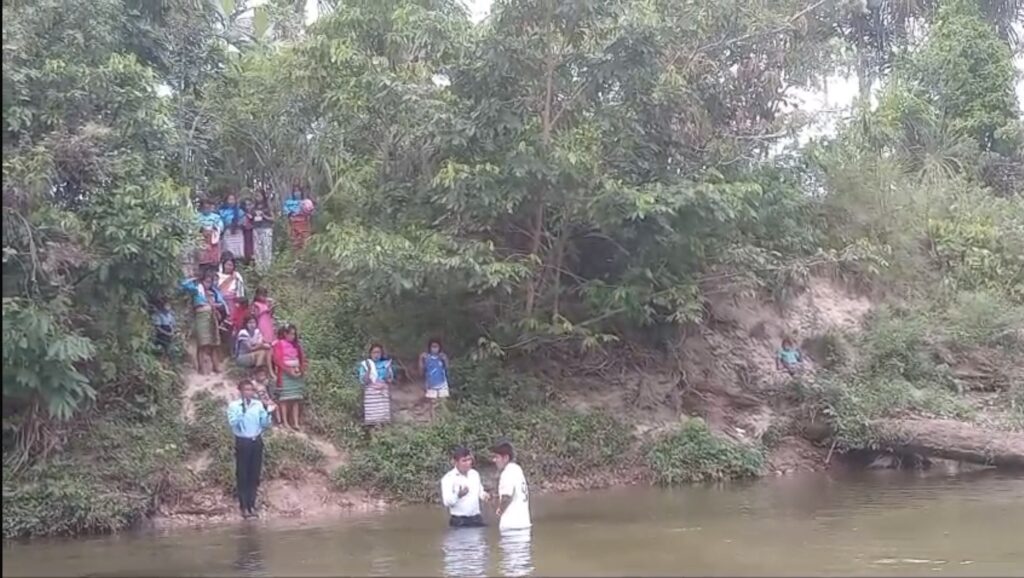
Late Tuesday night, my phone dinged. I picked it up. It was a 4:50-minute video from Peru. I hit play.
The video was shaky and grainy. A brown, muddy river filled the screen. A man stood alone in the waist-deep water. Across the river, a crowd gathered on a hillside, men and women in bright clothes, with children wandering around their feet. Then a young man stepped into the river.
The people on the hillside began to clap and sing. No instruments. Just voices singing in a foreign tongue. The man in the water said something to the young man, but I couldn’t hear him over the singing. Then he baptized him.
The young man climbed out of the river, and a young woman took his place.
Then another.
And another.
And suddenly I recognized the song. “I have decided to follow Jesus.”
Under the video was the single line of text: the church at Puerto Porvenir. I loved it.
I remembered my first trip to Puerto Porvenir. We tried to meet in a man’s house, but it was too small to fit everyone, so they tore out the back wall. That night, the generator hummed in the darkness as I preached from Isaiah 40. I usually can’t remember what I preached five minutes after the fact, but for some reason, I still remember that sermon.
A voice says, “Cry out.”
And I said, “What shall I cry?” “All people are like grass, and all their faithfulness is like the flowers of the field.
The grass withers and the flowers fall, because the breath of the LORD blows on them.
Surely the people are grass. The grass withers and the flowers fall, but the word of our God endures forever.” ~ Isaiah 40:6-8 NIV
I wanted to make one point: life is fragile and fleeting.
But as I read those words, I felt the Lord say in my spirit, “Cry out, Josh!” So, I did. I yelled at the top of my lungs, “ALL PEOPLE ARE LIKE GRASS!”
My life will wither.
But God endures.
At least that was the sermon I preached.
As the video ended, I sat there holding my phone in the dark, but it was a strange feeling. I was joyful. Thankful, even. But underneath that was something else.
What was it? Then I identified it.
I wanted to be there. I wanted to stand on that riverbank, clapping and singing as I had so many times before, with tears running down my face.
Over the years, I had developed a rhythm for baptisms in the villages. If someone decided to follow Christ and wanted to be baptized, I would plan a small teaching time. I would invite those who had made a decision of faith and wanted to take that next step.
Then I would find a local Christian leader and invite him to “help” me teach the class.
It happened often enough that I kept a small piece of paper permanently tucked inside my Bible. On it I had written a list of passages about baptism. Together, we would walk through those passages and talk about what baptism was and what it meant.
Then, when the class was over, I would turn to the leader.
“When we go down to the river, I am going to stand on the bank. You are going to do the baptizing.”
There was almost always a moment when the blood drained from his face.
“No, hermano.”
I would put my hand on his shoulder and encourage him as we walked toward the river. Then I would stand on the bank, clapping and singing, always with tears in my eyes. The tears were twofold: I was watching someone publicly choose to follow Jesus – what a moment – and if that doesn’t bring tears to your eyes, then you’re in the wrong business; and I was also watching a young leader step into his calling.
Sitting in the dark, watching the video from Puerto Porvenir, I began asking questions the video could not answer.
Who taught the baptism class?
Who explained what baptism meant?
Who put his hand on the shoulder of a frightened leader and told him, “You’ve got this hermano”?
Then came the question I did not want to admit:
Could they do it like I did?
Wow. There it was. The feeling I was feeling underneath was self-importance. Or this quiet thought that no one can do it like I can. Superiority.
The feeling caught me off guard.
Of course they did not do it like I did. And they shouldn’t.
I had spent years saying that the work could not depend on me. We trained local leaders because we wanted them to lead. We wanted the church to keep discipling people, sharing the gospel, and baptizing new believers long after we were gone.
Now it was happening.
And some part of me still wanted to be necessary.
But the grainy video on my phone told the truth. The church had gathered. Someone had taught. A leader had stepped into the water. New believers were being baptized. The people were singing.
God was still working.
And here I was 3,000 miles from Puerto Porvenir, and 9 months removed from Peru, watching the church continue.
Appropriately, the next morning I was in a Zoom call for the first meeting of the Church Strengthening working group. We had assembled eight missionaries from all over the world with way more experience and knowledge than I have. The entire point of forming this group was simple.
“We have needs all over the world,” I told them. “We have opportunities to partner with local ministries, train pastors, and plant new churches. But this cannot depend on us. And it cannot depend on Missionary Ventures. It must depend on the Holy Spirit.”
“We are tasked with finding sustainable ways to do ministry so that long after the missionary is gone, and long after Missionary Ventures is gone, the work will continue.”
I told them about the video I had received the night before.
“This is what we want to do all over the world,” I said.
I wanted to shout it again, “ALL PEOPLE ARE GRASS!” but refrained. I’m not sure how shouting sounds on Zoom.